Effort is not edge. Some of the hardest working traders in the world are also the poorest ones.
Picture the trader everyone admires. Six monitors. Sixteen hours a day. Eyes red, coffee cold, forty trades before lunch because he is grinding, he is hustling, he is putting in the work. Ask anyone in his life and they will tell you the same thing: nobody works harder than that guy. And they are right. Nobody does. He is also broke, and he is going to stay broke, and the terrible irony is that the work is the reason.
I have been trading for twenty years and I am going to tell you something that took me an embarrassing number of those years to accept. Almost every genuinely profitable stretch of my career came when I was trading less, had fewer trades and shorter sessions. Days where I was completely done in thirty minutes and the hardest thing I did all afternoon was decide where to eat. It is not a sin to be finished trading in half an hour. In this business it might be the closest thing there is to a virtue.
The Five Hundred Year Old Lie
To understand why traders destroy themselves with effort, you have to go back a long way. For centuries the Western world has been running on a piece of religious software that says work is moral. Not useful. Moral. The Protestant work ethic taught that labour itself was devotion, that idle hands did the devil’s work, that your worth before God could be read in your calluses. Sociologists literally wrote books about how this belief built modern capitalism. It is in the water and you absorbed it, and began living before you could walk.
The trouble is, for most of our history before technology and the rapidly evolving economy, this theory held true. Hard work always paid off. The hardworking brickie always made more because he did more, built more and so, brought more to the market. In a factory, hours in equals output out. On a farm, the man who works the field longer harvests more. In an office, face time gets promotions. Effort scales. So we built an entire civilisation around a simple equation: more work equals more reward. Suffer now, prosper later. Grind is godliness and for our entire lives and our ancestors lives, it’s been accurate. So accurate that the lazy and the no hard workers got taken out of the evolutionary chain. Darwin has ingrained into our DNA that hard work is the answer. But is it still true? The short answer is, well yes mostly but trading is a unique business and requires a shuffle of our automatic beliefs we carry with us. The average normal functioning person today has deeply held, even evolved beliefs that simply put hard work at the top or near the top of our traits we strive for, brag about and even fib about. The “I work 80 hours every week” line is almost always a gross exaggeration if not outright lie. The average person takes this belief and applies it to almost every aspect of life.
Then that person walks into the market carrying five thousand years of conditioning, and the market does something no priest, boss, or coach ever prepared them for. It ignores the effort completely. There is no conveyor belt here. The market does not pay you for being present. It does not pay for hours logged, screens watched, or trades taken. It pays for being right, and being right almost never requires being busy. The work ethic that built the modern world is precisely the operating system that bankrupts traders, because they are running factory installed software on a casino floor and calling it the grind, the battle, blood sweat and tears and just plain hard work.
The Numbers Do Not Care How Hard You Tried
This is not philosophy. It is arithmetic, and the arithmetic is brutal. Depending on which study you read, somewhere between 80 and 95 percent of day traders lose money. Research on Taiwanese traders found less than one percent were consistently profitable after fees. A Brazilian study followed traders who persisted for more than 300 days, the grinders, the ones who refused to quit, and found 97 percent of them lost money. Read that again. The ones who stuck with it the longest and worked at it the hardest had the worst survival rate of all.
But the study that should be framed on every trader’s wall came out of Berkeley, and the academics gave it a title I could not improve on: Trading Is Hazardous to Your Wealth. They analysed tens of thousands of accounts and found the average investor underperformed the market by about 1.5 percent a year. Not great. But the most active traders, the hardest workers, the ones taking trade after trade after trade? They underperformed by 6.5 percent a year. The harder the sample worked, the poorer it got. Activity was not the path to the reward. Activity was the tax.
So when you hear that famous failure rate and picture a crowd of lazy dreamers who did not want it badly enough, invert the picture. Most of them wanted it desperately. Most of them worked at it exactly the way they were taught to work at everything, and that is why the statistic exists. The failure rate is not happening despite all the hard work. A meaningful share of it is happening because of it.
The Goalkeeper Problem
There is a famous study on penalty kicks that explains more about trading than most trading books. Researchers analysed hundreds of penalties and found that goalkeepers dive left or right about 94 percent of the time, even though the statistics showed they would stop more shots by simply standing in the centre of the goal. The keepers were asked why. The answer was human to the bone: diving feels like doing something. A keeper who dives the wrong way made an effort. A keeper who stands still while the ball flies past looks like he did not even try, and he cannot bear it, so he dives. Worse odds, better optics.
That is the Western action bias in one image, and traders live it every single day. We are trained from childhood that action is always the answer. In sports, hesitation loses. In business, the go getter eats first. React fast, move first, do something. So the trader sits down, the chart ticks, and five centuries of conditioning plus a lifetime of coaching screams dive. Price moves against the position, dive. Price does nothing for twenty minutes, dive anyway, because sitting still feels like negligence.
Here is what nobody taught us: inaction IS an action. Standing in the centre of the goal is a decision, and often the statistically superior one. Flat is a position. Cash is a position. Watching a choppy market do nothing, and matching it by doing nothing, is not laziness. It is the correct trade, executed perfectly, with a profit and loss of exactly zero, which on a chop day puts you ahead of nearly everyone diving at every tick.
Herding Cats and the Art of Sitting Still
Trading profits behave like cats. Chase them around the room and they vanish under the furniture. The harder you pursue, the more completely they escape you. Sit down, go still, stop wanting it so visibly, and eventually the cat walks over and sits in your lap like it was its own idea. Every experienced trader knows this feeling and almost none of us can explain it to beginners, because it violates everything the beginner has ever been taught about how rewards work.
The East figured this out centuries before candlestick charts existed. Zen practice is built on a concept our culture barely has words for: the idea that being is itself the way, that there is a kind of action inside stillness, and that the person who must react to every stimulus is not strong but enslaved. A mind that jumps at every tick is a mind the market owns. A mind that can watch the tick, feel the pull, and simply remain, that mind belongs to its owner, and it is the only kind of mind that survives twenty years in this game.
Jesse Livermore, who knew a few things about markets, said the big money was never made by his thinking. “It always was my sitting.” The sitting. Not the screen time, not the trade count, not the sixteen hour heroics. The sitting. The old lion does not chase everything on the savannah. He sleeps most of the day, watches, and moves once, when the odds are absurd in his favour. Nobody accuses the lion of a poor work ethic. He is simply not confused about what his job is.
Where the Hard Work Actually Goes
Now, before anyone hears this as a hymn to laziness, let me be extremely clear. I am not telling you to stop working hard. I am telling you to stop aiming it at the one place where it detonates. The work ethic is an engine, and it is a magnificent engine. The problem was never the horsepower. The problem is pointing it at the charts, where more throttle means more trades, more fees, more emotional leaks, and more of that 6.5 percent tax the Berkeley grinders paid.
So redirect the engine. Market chopping sideways with no setup in sight? That is not a trading day, that is a gym day. Work savagely hard there. Work hard learning the new concept, backtesting the idea, reviewing the journal, studying the losing trades until they confess. Work hard on your sleep, your health, your family, the business around the trading. One of the reasons we built this community is to get our traders off the screen more and interact with other mandatory aspects of a successful and healthy life. Build the person, sharpen the process, strengthen everything that surrounds the moment of execution. And then, when the actual setup arrives, the one you have been patiently not chasing, the execution itself should feel almost effortless. Thirty minutes. One good trade or none at all. Done.
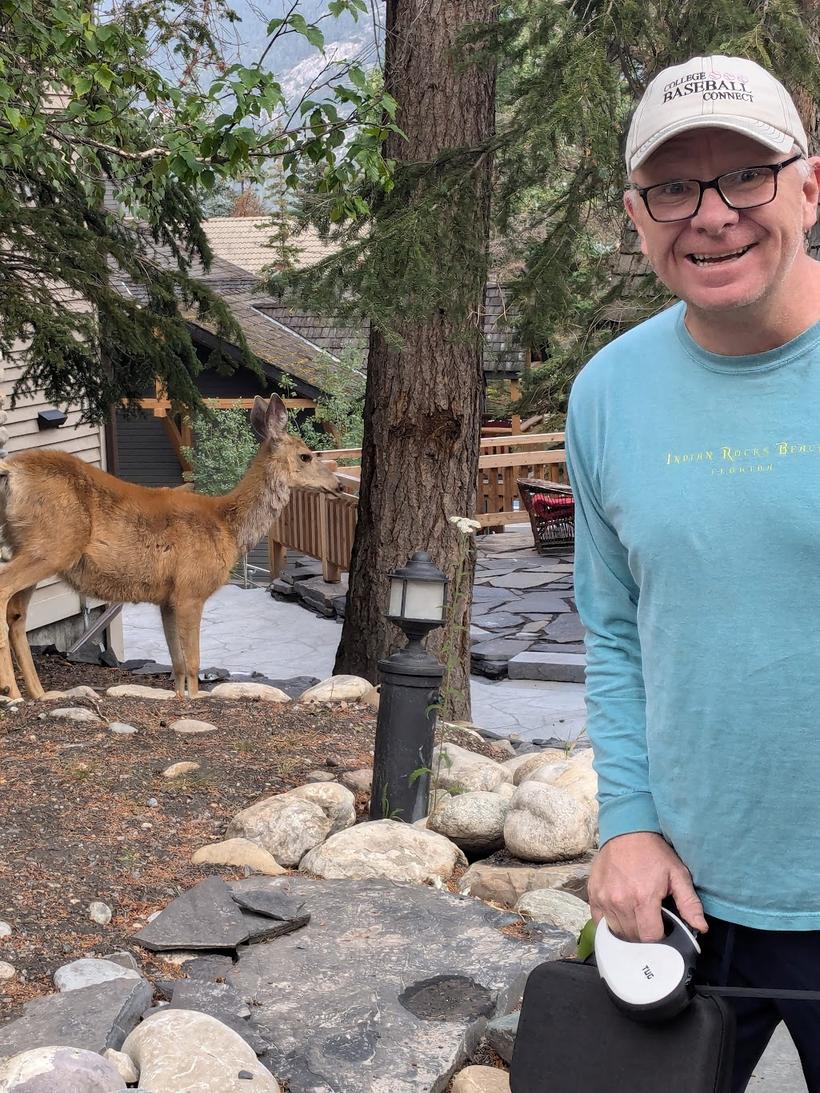
There is more to life than charts. Step away from the screens and the world shows up.
That is what working hard at trading actually looks like from the inside, and I promise you it looks like laziness from the outside. The neighbours see a man at a palapa in Mazatlán closing his laptop before lunch. They do not see the twenty years of reps behind the thirty minutes, or the discipline it takes to do nothing while every cell of your conditioning howls at you to dive.
The market is open around 24 hours a day, five days a week. That is not an invitation. It is a test, and most people fail it with maximum effort. Show up, take what is cleanly offered, refuse everything else, and go live your life. The account does not grow because you suffered for it. It grows because you stopped confusing suffering with skill.

Make time for the people and the moments you love. The market rewards the trader who has a life outside it.